MIT PROCESSING , Made in Taiwan






謙聖國際法律事務所-專精詐欺、毒品刑事辯護及侵害配偶權律師

店家商品

商品名稱
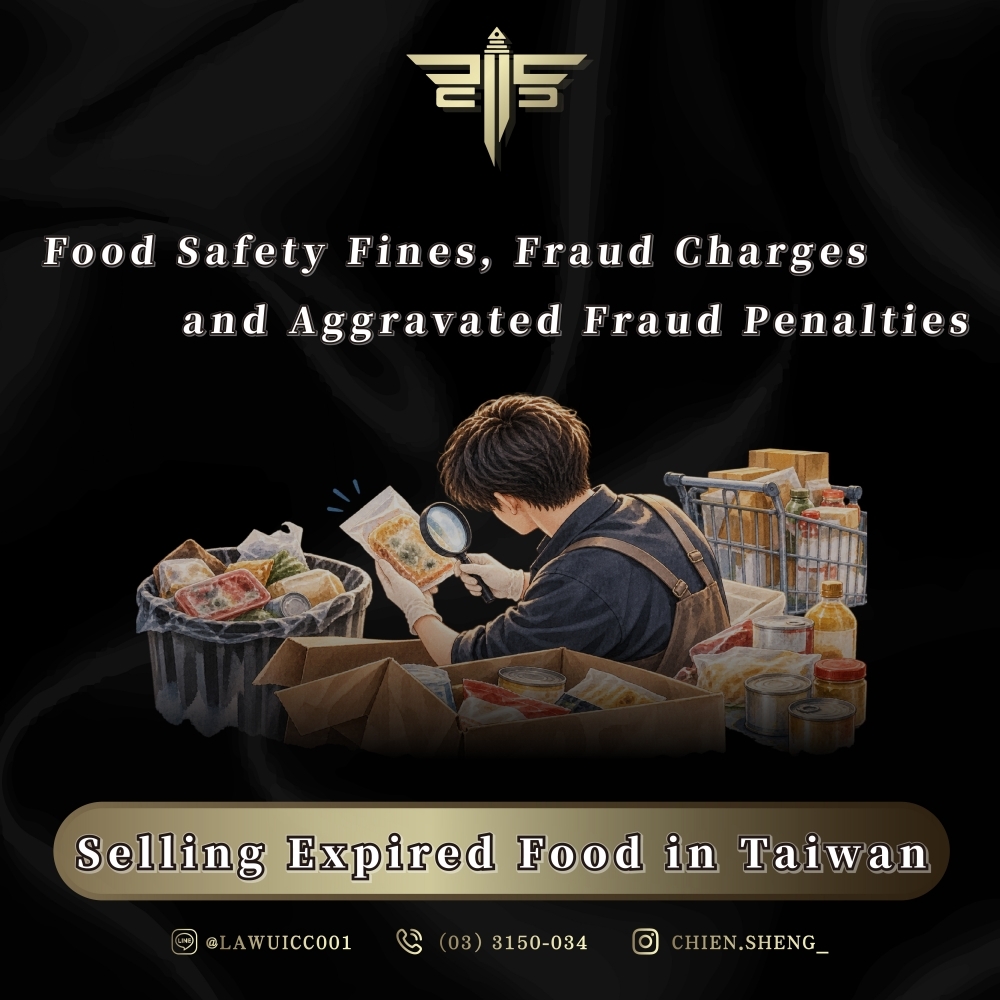
Selling Expired Food in Taiwan: Food Safety Fines, Fraud Charges, and Aggravated Fraud Penalties
目錄
- 1. Is Selling Expired Food Illegal in Taiwan?
- 2. What Are the Administrative and Criminal Penalties for Selling Expired Food?
- 3. When Does Selling Expired Food Become Criminal Fraud?
- 4. Can Selling Expired Food Lead to Aggravated Fraud Charges?
- 5. Can Changing Expiration Labels Be a Separate Criminal Offense?
- 6. Can Consumers Claim Compensation for Expired Food?
- 7. What Should Businesses and Consumers Do After Discovering Expired Food?
- 8. What Are the Main Legal Defense Strategies in Expired Food Cases?
- 9. Frequently Asked Questions About Selling Expired Food in Taiwan
- 10. Conclusion: Expired Food Cases Require More Than a Simple Food Safety Assessment
Selling expired food in Taiwan can lead to more than refunds or administrative fines. Food manufacturers, restaurants, retailers, online sellers, and company executives may also face criminal investigations if expired products are deliberately relabeled, repackaged, or sold as safe and unexpired goods.
Depending on the circumstances, a case may involve Taiwan's Act Governing Food Safety and Sanitation, ordinary fraud under Article 339 of the Criminal Code, aggravated fraud under Article 339-4, false commodity labeling, and civil compensation.
The key legal question is not simply whether the food was expired, but whether the seller knew, concealed material information, deceived consumers, or created a serious health risk.
Table of Contents
■ Is Selling Expired Food Illegal in Taiwan?
■ Administrative Fines and Criminal Food Safety Penalties
■ When Does Selling Expired Food Become Fraud?
■ Can Three or More Employees Be Charged with Aggravated Fraud?
■ False Expiration Dates and Commodity Labeling Offenses
■ Consumer Compensation and Civil Liability
■ What Should Businesses and Consumers Do?
■ Legal Defense Strategies for Expired Food Cases
■ Frequently Asked Questions and Conclusion
1. Is Selling Expired Food Illegal in Taiwan?
1. Article 15 of the Act Governing Food Safety and Sanitation
Article 15, paragraph 1, subparagraph 8 of Taiwan's Act Governing Food Safety and Sanitation prohibits specified activities involving food or food additives that have passed their expiration dates.
The restrictions include manufacturing, processing, packaging, transporting, storing, selling, importing, exporting, publicly displaying, and distributing expired products as gifts.
Businesses cannot avoid these restrictions simply by labeling expired products as clearance items or selling them at a discount.Food that is approaching its expiration date is different from food that has already expired.
2. Does an Expired Product Automatically Constitute Fraud?
➡︎ No.
An expired product may establish a food safety violation, but criminal fraud requires additional elements.
➠ For example, a store that accidentally fails to remove expired products may face administrative penalties without necessarily having committed fraud.
By contrast, deliberately changing expiration dates or knowingly presenting expired food as fresh may raise criminal concerns.
2. What Are the Administrative and Criminal Penalties for Selling Expired Food?
1. Administrative Fines Under Article 44
Violations of Article 15 may result in administrative fines ranging from NT$60,000 to NT$200 million under Article 44.
In serious cases, authorities may also impose business suspension, closure-related measures, or revocation of relevant registrations.
The penalty may depend on the scale of the violation, duration of sales, product quantity, previous violations, consumer harm, and corrective actions.
Businesses should review inspection records, expiration dates, inventory classifications, and the authority's factual findings before deciding whether to pursue administrative remedies.
2. When Can Article 49 Lead to Criminal Charges?
Not every violation involving expired food automatically triggers criminal liability under Article 49.The provision distinguishes different categories of serious food safety violations.
Although expired food under Article 15, paragraph 1, subparagraph 8 is not itself among the specific violations directly listed in Article 49, paragraph 1, other provisions may apply when the statutory conditions are met.
Under Article 49, paragraph 2, serious violations that a sufficient risk to human health may be punishable by imprisonment of up to seven years and a possible additional fine of up to NT$80 million.
Where the conduct actually causes harm to human health, the statutory penalty may increase to imprisonment of one to seven years, with a possible additional fine of up to NT$100 million.
Cases involving death or serious bodily injury may carry heavier penalties.
Investigators may examine the type of food, degree of expiration, storage conditions, extent of distribution, consumer injuries, and evidence of deliberate concealment.
A minor inventory oversight and a large-scale operation deliberately relabeling expired food may have very different legal consequences.
3. When Does Selling Expired Food Become Criminal Fraud?
1. Fraud Under Article 339 of Taiwan's Criminal Code
Article 339 addresses obtaining another person's property through deception with unlawful intent.
The statutory penalty for ordinary fraud is imprisonment of up to five years, short-term imprisonment, or a fine of up to NT$500,000, which may also be imposed in addition to imprisonment.
In an expired food case, prosecutors may investigate whether the seller knowingly concealed the expiration date or falsely represented the product's quality to induce consumers to pay.
➠ Examples may include changing expiration labels, repackaging expired food, falsely advertising products as fresh, or knowingly providing inaccurate information when customers ask about expiration dates.
2. Negligence Is Not Automatically Fraud
Fraud requires proof of the relevant criminal intent, deceptive conduct, the victim's mistaken belief, the transfer of property, and the necessary causal connection.
➠ If expired food was sold because of an inventory system error, employee oversight, or an accidental shipping mistake, administrative or civil liability may still arise.
However, those facts do not automatically establish intentional criminal fraud.The distinction between negligent management and deliberate deception is often central to the defense.
4. Can Selling Expired Food Lead to Aggravated Fraud Charges?
1. Fraud Committed Jointly by Three or More People
Article 339-4 of Taiwan's Criminal Code provides enhanced penalties for fraud committed under specified aggravating circumstances.
These include fraud committed jointly by three or more people.The statutory penalty is imprisonment of one to seven years, with a possible additional fine of up to NT$1 million.
In a food business, investigators may examine whether purchasing managers, warehouse employees, labeling staff, sales personnel, and company executives knowingly participated in a coordinated fraudulent operation.
However, the mere fact that a company employs three or more people does not establish aggravated fraud.The prosecution must establish the required fraudulent conduct and each alleged participant's knowing involvement and shared criminal intent.
2. Fraud Through Online Stores, Livestreams, or Social Media
Article 339-4 also addresses certain fraud offenses committed through public dissemination using the internet, electronic communications, or other media.
➠ If expired products are knowingly advertised as fresh through an online store, livestream, or public social media campaign, this aggravating circumstance may become relevant.
Nevertheless, operating an e-commerce business does not automatically constitute aggravated fraud.Prosecutors must still prove the underlying fraud offense and the statutory aggravating elements.
5. Can Changing Expiration Labels Be a Separate Criminal Offense?
1. False Commodity Labeling Under Article 255
Article 255 of Taiwan's Criminal Code addresses deceptive false representations concerning a product's origin or quality.
The offense may carry imprisonment of up to one year, short-term imprisonment, or a fine of up to NT$30,000.Knowingly selling certain falsely labeled products may also fall within the provision.
Changing expiration dates, covering original labels, or repackaging expired food with misleading information may raise questions about false representations of product quality.
2. How Is False Labeling Different from Fraud?
Ordinary fraud focuses on deception that causes a victim to transfer property.False commodity labeling focuses on prohibited deceptive representations about the product itself.
A single incident may raise issues under more than one criminal provision, although the final legal treatment depends on the facts and rules governing overlapping offenses.
Evidence such as relabeling equipment, packaging materials, internal instructions, and employee communications may be important.
Businesses that discover incorrect labels should stop affected sales, preserve records, and investigate rather than quietly replacing labels or disposing of evidence.
6. Can Consumers Claim Compensation for Expired Food?
1. Consumer Protection Act Article 7
Article 7 of Taiwan's Consumer Protection Act establishes safety obligations for businesses providing goods or services.
Where the statutory requirements are met, businesses may be liable for damage caused by unsafe products.Potential claims may involve medical expenses, lost income, and other legally recoverable losses.
2. Civil Code Article 184
Article 184 of Taiwan's Civil Code provides a basis for tort liability in applicable circumstances involving intentional or negligent unlawful harm.
➠ If a consumer suffers food poisoning or another health injury after consuming expired food, the claim may require evidence of the injury, the product involved, causation, and the claimed losses.
Depending on the circumstances, compensation may include medical costs, lost earnings, and non-pecuniary damages.Businesses should evaluate consumer compensation alongside administrative and criminal exposure.
Refunding customers or reaching a settlement may be appropriate, but settlement documents should accurately reflect the facts and should not contain unnecessary or inaccurate admissions.
7. What Should Businesses and Consumers Do After Discovering Expired Food?
1. Steps for Businesses Under Investigation
➠ If health authorities inspect a store, warehouse, or food company, the business should preserve purchase records, batch numbers, expiration labels, storage logs, shipping records, and relevant communications.
It should also determine who was responsible for purchasing, inventory management, labeling, sales, and shipping.
Corrective actions may include removing affected products, arranging recalls, notifying customers, issuing refunds, and improving inventory controls.
These measures do not automatically eliminate liability, but they may be relevant to the administrative response, settlement discussions, and criminal proceedings.Businesses should avoid deleting records, changing labels after the fact, or instructing employees to coordinate inaccurate statements.
2. Steps for Consumers Who Purchased Expired Food
Consumers should retain the product, packaging, expiration label, receipt, online listing, and relevant communications.
➠ If illness occurs, seek medical attention and preserve medical documentation.Consumers may contact the seller, local health authorities, or consumer protection officials to pursue appropriate remedies.
Where there is evidence of deliberate relabeling, concealment, or fraudulent sales, a criminal complaint may also be considered.
8. What Are the Main Legal Defense Strategies in Expired Food Cases?
1. Determine Whether the Conduct Was Intentional
A central defense issue is whether the accused actually knew that the products had expired and intentionally deceived consumers.
Inventory errors, unclear internal responsibilities, inaccurate supplier information, and employee mistakes may require separate examination.
2. Examine Each Person's Role
Company executives, warehouse staff, customer service representatives, and online sellers may have different levels of knowledge and responsibility.
Participation in ordinary business operations does not automatically establish participation in a criminal conspiracy.
3. Review the Evidence of Consumer Deception
Investigators may rely on advertising statements, product labels, internal messages, sales records, and consumer complaints.
The defense should determine whether these materials establish deliberate deception or instead support an administrative or civil dispute.
4. Evaluate Health Risks and Corrective Measures
Food safety criminal liability may depend on the seriousness of the violation and the evidence of health risks or actual harm.
Product testing, storage records, recall documentation, and medical evidence may be important.
5. Legal Assistance from Chien Sheng International Law Firm
 Chien Sheng International Law Firm assists businesses, company executives, retailers, online sellers, employees, and consumers with disputes involving expired food products.
Depending on the case, legal services may include administrative investigation responses, police and prosecutorial questioning, evidence analysis, fraud defense, aggravated fraud allegations, administrative appeals, and civil settlement negotiations.
The objective is to distinguish the actual regulatory violation from criminal allegations that require additional proof.
9. Frequently Asked Questions About Selling Expired Food in Taiwan
Q1: Is selling expired food always a criminal offense in Taiwan?
No. Selling expired food may violate the Act Governing Food Safety and Sanitation and result in administrative penalties. Criminal liability requires the additional elements of an applicable criminal offense.
Q2: Can a business sell expired food at a discount?
No. Labeling food as discounted or clearance stock does not generally permit the sale of products that have already passed their expiration dates.
Q3: What is the maximum administrative fine for selling expired food?
Article 44 provides fines ranging from NT$60,000 to NT$200 million for applicable violations.
Q4: Can a company be charged with aggravated fraud if three employees handled expired products?
Not merely because three employees were involved. The prosecution must establish the underlying fraud and the required knowing participation of at least three people.
Q5: Does selling expired food online automatically constitute aggravated fraud?
No. Online sales alone are insufficient. The statutory elements of fraud and the relevant public-dissemination aggravating circumstance must be established.
Q6: Can changing an expiration date lead to criminal charges?
Yes. Deliberately falsifying expiration information may raise issues involving fraud, false commodity labeling, or other applicable offenses.
Q7: Can consumers claim compensation if they become ill after eating expired food?
Potentially. Consumers may pursue compensation under applicable consumer protection and civil liability provisions if the legal requirements, including damage and causation, are established.
10. Conclusion: Expired Food Cases Require More Than a Simple Food Safety Assessment
Selling expired food in Taiwan may involve administrative fines, criminal food safety liability, fraud allegations, aggravated fraud, false commodity labeling, and civil compensation.
However, these consequences are not interchangeable.A food safety violation does not automatically establish fraud, and the involvement of multiple employees or an online sales platform does not automatically establish aggravated fraud.
The legal assessment must consider knowledge, intent, product labeling, consumer deception, health risks, individual responsibilities, and the available evidence.
Businesses facing inspections or criminal investigations should preserve records, address affected products promptly, and obtain legal advice before making statements or settlement decisions that may affect their legal position.
Chien Sheng International Law Firm provides legal assistance in Taiwan for businesses and individuals facing food safety investigations, fraud allegations, and related civil or administrative disputes.
※ Legal Disclaimer: This article provides general information about Taiwanese food safety, criminal, and civil laws. Actual liability depends on the applicable statutory provisions, facts, evidence, and circumstances of each case. No particular administrative, prosecutorial, or judicial outcome can be guaranteed.
This reduces both medical risks and potential legal exposure.
Chien Sheng International Law Firm
LINE Online Legal Consultation: @lawuicc001 (Click to consult)
Welcome to call to schedule a meeting: 03-3150-034
Multiple payment methods available: Cash, Credit Card, Bank Transfer
Facebook: Chien Sheng International Law Firm
Instagram: chien.sheng_
其它相關店家資訊


免責聲明本網站僅提供製造業公司資訊參考平台, 並不涉入其中任何諮詢、交易。本網站對各該製造業公司相關資訊亦不作任何實質或形式上之審查。就本網站中所載一切製造業公司的資訊、文字、照片、圖形 、產權、廣告內容、或其他資料(以下簡稱『內容』),無論其為公開張貼或私下傳送,若有不實或違法情事,均為『內容』提供者之責任,本站概不負責也不承擔任何法律責任