MIT PROCESSING , Made in Taiwan






謙聖國際法律事務所-專精詐欺、毒品刑事辯護及侵害配偶權律師

店家商品


商品名稱
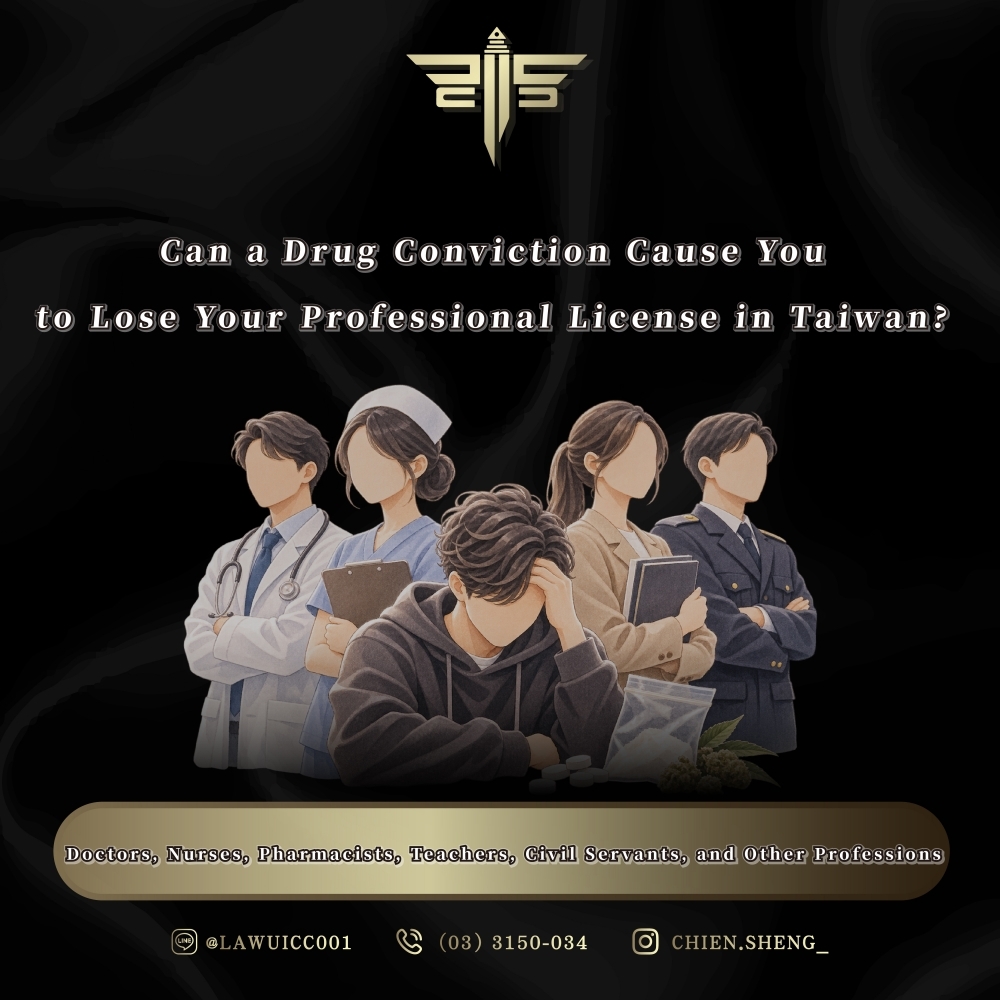
Can a Drug Conviction Cause You to Lose Your Professional License in Taiwan? Doctors, Nurses, Pharmacists, Teachers, Civil Servants, and Other Professions
Table of contents
- 1. Professional Certificates, Practice Licenses, and Employment Eligibility
- 2. Doctors, Dentists, Nurses, and Pharmacists
- 3. Other Healthcare Professionals
- 4. Teachers and Educational Personnel
- 5. Civil Servants
- 6. Lawyers
- 7. Security Guards
- 8. Social Workers and Veterinarians
- 9. What to Check After a Drug Conviction
- 10. Legal Defense and Professional Qualification Protection
- 11. Frequently Asked Questions About Drug Convictions and Professional Licenses in Taiwan
- 12. Conclusion: Drug Convictions and Professional Qualifications Must Be Evaluated Separately
A drug conviction in Taiwan may affect more than criminal penalties. For licensed professionals and public-sector employees, one of the greatest concerns is whether they can continue working after a drug-related case.
However, a drug conviction does not automatically result in the loss of every professional license or employment qualification.
The consequences depend on the profession, applicable legislation, criminal offense, sentence, suspended sentence status, whether the judgment is final, and whether the conduct relates to professional duties.
➠ A first-instance conviction under appeal is not necessarily equivalent to a final criminal judgment. Nevertheless, some employment restrictions use different statutory requirements, so an ongoing appeal does not automatically eliminate every professional risk.
※ This article explains how drug-related convictions may affect professional certificates, practice licenses, employment eligibility, and disciplinary proceedings in Taiwan.
1. Professional Certificates, Practice Licenses, and Employment Eligibility
1. These Legal Consequences Are Not the Same
A professional certificate generally establishes that an individual possesses a legally recognized professional qualification, such as a physician, pharmacist, or social worker certificate.
A practice license is a separate authorization that may be required to perform professional services legally.
➠ Revocation or cancellation of a professional certificate may also affect an existing practice license, but the two documents have different legal functions.
Employment restrictions are another category. Civil servants may face disqualification from appointment, teachers may face dismissal or restrictions on future employment, and security guards may be prohibited from performing certain duties.These consequences should not all be described as professional license revocation.
2. The Stage of Criminal Proceedings Matters
An investigation, indictment, first-instance judgment, appeal, and final conviction represent different stages of criminal proceedings.
Some professional laws expressly require a final criminal conviction before particular qualification restrictions apply.Other laws use different wording or establish separate employment and disciplinary requirements.
➠ The type of drug offense, sentence imposed, suspended sentence status, completion of punishment, and restoration of civil rights may also affect the outcome.
2. Doctors, Dentists, Nurses, and Pharmacists
1. Physicians and Dentists: Article 5 of the Physicians Act
Article 5, Subparagraph 2 of Taiwan's Physicians Act provides that a person convicted and sentenced under the Narcotics Hazard Prevention Act by a final judgment is disqualified from practicing as a physician.
Where the individual already holds a physician certificate, the law provides for revocation or cancellation of that certificate.The provision does not expressly establish a minimum imprisonment term or limit its application to particular categories of drug offenses.
Under Article 8-1, loss of the physician certificate may also prevent the issuance of a practice license or affect an existing one.Dentists are also subject to the Physicians Act.
➠ Separately, Articles 25 and 25-1 address professional disciplinary proceedings, including certain crimes committed through professional activities. These disciplinary provisions should not be confused with the qualification restrictions under Article 5.
2. Nurses: Article 6 of the Nursing Personnel Act
Article 6, Subparagraph 2 of the Nursing Personnel Act establishes a similar restriction for nursing personnel convicted and sentenced under the Narcotics Hazard Prevention Act by a final judgment.
➠ The provision may affect both registered nurses and other nursing personnel covered by the Act.Where the statutory conditions are satisfied, the professional certificate may be revoked or cancelled.
Articles 8 and 9 separately regulate practice registration and licensing, meaning that loss of professional certification may also affect the ability to practice legally.
➠ The statute does not expressly provide a general exemption for every suspended sentence, fine conversion, or completed sentence. These circumstances require individual legal analysis.
3. Pharmacists: Article 6 of the Pharmacists Act
Article 6, Subparagraph 2 of the Pharmacists Act provides that a person convicted and sentenced under the Narcotics Hazard Prevention Act by a final judgment may be disqualified from holding pharmacist qualifications.
➠ An existing pharmacist certificate is subject to the statutory revocation or cancellation provisions.Articles 7 and 11 address practice registration and the consequences for practice licenses when professional certification is lost.
➠ Additionally, Articles 21 and 22 provide for disciplinary proceedings involving certain crimes committed through professional activities.A pharmacist's drug conviction may therefore raise both qualification and disciplinary issues, depending on the facts.
3. Other Healthcare Professionals
The professional statutes governing medical laboratory technologists, medical radiologic technologists, physical therapists, and occupational therapists do not contain the same express drug-conviction disqualification provisions identified in the Physicians Act, Nursing Personnel Act, and Pharmacists Act.
➡︎ This does not mean that drug-related conduct can never affect these professions.
Professional misconduct, violations connected to clinical duties, or statutory findings that an individual is objectively unable to practice may trigger separate regulatory consequences.
However, a drug conviction should not automatically be treated as grounds for license revocation unless the relevant statutory requirements are satisfied.Each profession must be assessed under its own governing legislation.
4. Teachers and Educational Personnel
1. A Drug Conviction Does Not Automatically Cancel Every Teaching Certificate
Taiwan's Teachers' Act does not establish a universal rule that every conviction under the Narcotics Hazard Prevention Act automatically cancels a teaching certificate or permanently prohibits teaching.
Nevertheless, drug-related misconduct may fall within broader provisions governing violations of law, professional suitability, dismissal, and restrictions on future employment.
2. Dismissal and Restrictions on Future Employment
Articles 14 and 15 of the Teachers' Act address circumstances in which unlawful conduct may justify dismissal and, depending on the statutory conditions, permanent or time-limited restrictions on future teaching appointments.
➡︎ The assessment may involve the seriousness of the conduct, its relationship to educational responsibilities, proportionality, and the required review procedures.
Article 19 further addresses restrictions on employment during statutory disqualification periods.Article 21 also provides for temporary suspension in certain circumstances, including specified criminal justice or imprisonment situations.
Temporary suspension, dismissal, permanent disqualification, and cancellation of a teaching certificate are different legal consequences and should not be treated as interchangeable.
5. Civil Servants
1. Drug Convictions and Appointment Restrictions
Taiwan's Civil Service Employment Act does not establish a separate universal disqualification rule specifically naming drug offenses.
➡︎ However, Article 28, Paragraph 1, Subparagraph 5 provides general restrictions concerning certain final sentences of imprisonment that have not yet been executed or fully served, with an express exception for suspended sentences.
Subparagraph 8 separately addresses individuals whose civil rights have been deprived and not restored.Accordingly, a drug conviction may affect civil service appointment when the statutory conditions are met.
2. Suspended Sentences and Completed Punishment
A suspended sentence may receive different treatment under the Civil Service Employment Act than under professional statutes governing physicians, nurses, or pharmacists.
Where the relevant imprisonment has already been fully executed, the statutory restriction concerning punishment not yet executed or completed must be assessed according to its wording.Other restrictions, including deprivation of civil rights, may still apply.
➡︎ For individuals already employed in public service, the consequences may involve dismissal or cancellation of appointment under the applicable provisions.
Special public-sector positions may also be governed by additional legislation.
6. Lawyers
1. Drug Convictions Do Not Automatically Revoke a Lawyer's License
Taiwan's Attorney Regulation Act does not provide that every drug conviction automatically disqualifies an individual from practicing law.
Under Article 5, Paragraph 1, Subparagraph 1, a final sentence of imprisonment of at least one year may affect eligibility for a lawyer's certificate where the nature and circumstances of the offense demonstrate harm to the reputation of the legal profession.
➡︎ The law also contains specified exceptions, including certain circumstances involving negligent offenses or suspended sentences that have expired without revocation.
Therefore, the sentence, finality of the judgment, nature of the offense, and statutory exceptions must all be examined.
2. Professional Disciplinary Proceedings
Articles 73 and 74 of the Attorney Regulation Act provide for disciplinary proceedings and sanctions in relevant circumstances.Possible disciplinary measures include professional education, warnings, reprimands, suspension from practice, and disbarment.
A drug conviction does not automatically produce the same result in every lawyer disciplinary case.The applicable statutory version and timing of the conduct, certification, and bar association membership may also matter.
7. Security Guards
1. Drug Convictions May Affect Eligibility to Work
Article 10-1, Paragraph 1, Subparagraph 2 of Taiwan's Security Services Act expressly addresses convictions under the Narcotics Hazard Prevention Act.
Where the statutory conditions are satisfied, an individual may be prohibited from working as a security guard.
Unlike professional licensing laws, this provision concerns employment eligibility rather than revocation of an individual professional practice license.
2. Statutory Exceptions Must Be Considered
➡︎ The Security Services Act contains exceptions involving certain suspended sentences, conversion of punishment to fines or other alternative forms of execution, completed fine sentences, and final acquittals.
➡︎ The exact effect depends on the judgment and execution records.
Security companies also have statutory obligations concerning employee qualification reviews and removal of personnel who become disqualified.Failure to comply may result in regulatory penalties against the employer.
8. Social Workers and Veterinarians
1. Social Workers: The Connection to Professional Duties Matters
Article 7 of Taiwan's Social Worker Act identifies several categories of criminal conduct affecting professional eligibility.
Drug offenses are not separately listed as an automatic disqualification category.
➡︎ However, intentional criminal conduct connected to professional duties may fall within the Act's broader qualification restrictions when the statutory requirements are satisfied.
Where a social worker certificate is revoked or cancelled, Article 10 may also affect the corresponding practice license.
Therefore, a drug conviction unrelated to professional duties should not automatically be treated as equivalent to a professional qualification violation.
2. Veterinarians: No General Automatic Drug-Conviction Revocation Rule
Taiwan's Veterinarians Act does not establish a general rule automatically revoking a veterinarian's practice license solely because of a final drug conviction.
Article 6 addresses specific grounds for refusing, revoking, or cancelling a practice license, including certain certification and professional capacity issues.
Other legislation may separately restrict the prescription, use, or dispensing of controlled drugs.Such restrictions should not be confused with automatic revocation of a veterinarian's professional license.
9. What to Check After a Drug Conviction
1. Review the Criminal Judgment
First, determine whether the case is still under investigation, awaiting trial, under appeal, or finally concluded.
Review the precise offense, sentence, suspended sentence status, any deprivation of civil rights, and whether the punishment has been executed.
➡︎ The legal consequences may differ substantially depending on these details.
2. Identify the Exact Professional Restriction
➡︎ The next step is to determine whether the relevant law concerns professional certification, a practice license, initial appointment, continued employment, temporary suspension, or disciplinary proceedings.
A prohibition against employment is not necessarily equivalent to cancellation of a professional certificate.Likewise, losing a professional certificate may have separate consequences for an existing practice license.
3. Examine Exceptions and Administrative Procedures
Suspended sentences, conversion to fines, completed imprisonment, and restoration of civil rights may have different effects under different professional laws.
If a regulatory authority, school, employer, or professional association has issued a notice, review the deadline for responding, the required documents, and the available administrative remedies.
Relevant materials may include the criminal judgment, proof of finality, sentence execution records, professional certificates, practice licenses, and employment documents.
10. Legal Defense and Professional Qualification Protection
A drug-related criminal case may involve both criminal liability and separate administrative or professional consequences.
When evaluating the case, legal counsel should consider not only the potential sentence but also whether a conviction could affect the person's professional qualification, employment eligibility, or ability to continue practicing.
 Chien Sheng International Law Firm assists clients with criminal matters and related legal issues concerning professional qualifications, licensing restrictions, employment consequences, and administrative proceedings.
Where an individual faces possible dismissal, license revocation, cancellation of professional certification, or disciplinary action, early review of the judgment and governing professional statute may help identify the applicable legal requirements and available remedies.
11. Frequently Asked Questions About Drug Convictions and Professional Licenses in Taiwan
Q1: Does a drug conviction automatically revoke a professional license in Taiwan?
No. The consequences depend on the profession, applicable law, criminal offense, sentence, and whether the judgment is final.
Q2: Can a doctor lose their medical license after a drug conviction?
Yes. The Physicians Act expressly provides qualification restrictions for certain final convictions under the Narcotics Hazard Prevention Act, which may also affect the practice license.
Q3: Can nurses and pharmacists lose their professional certificates because of drug convictions?
Yes. Their respective professional statutes contain express provisions concerning final drug convictions and professional qualifications.
Q4: Will a teacher automatically lose their teaching certificate after a drug conviction?
Not automatically. However, the conduct may trigger dismissal, temporary suspension, or restrictions on future employment under applicable education laws.
Q5: Can a person with a drug conviction become a civil servant?
Eligibility depends on the sentence, whether it is final, whether punishment remains unexecuted, suspended sentence status, and other statutory restrictions.
Q6: Does a suspended sentence protect someone from professional license revocation?
Not necessarily. Different professional statutes treat suspended sentences differently, and some do not expressly provide a general exemption.
Q7: Can a lawyer or security guard continue working after a drug conviction?
The outcome depends on the applicable professional or employment statute. Lawyers may face qualification or disciplinary proceedings, while security guards are subject to specific statutory employment restrictions and exceptions.
12. Conclusion: Drug Convictions and Professional Qualifications Must Be Evaluated Separately
A drug conviction in Taiwan does not automatically mean that every professional must lose their license or employment.
Physicians, dentists, nurses, and pharmacists are subject to express statutory restrictions involving certain final drug convictions. Security guards also face specific employment restrictions, subject to statutory exceptions.
➡︎ For teachers, civil servants, lawyers, social workers, veterinarians, and other healthcare professionals, the consequences depend on the applicable qualification, employment, professional misconduct, or disciplinary provisions.
The most important distinction is between criminal punishment and the separate legal consequences affecting professional qualifications.
Before assuming that a drug conviction will automatically end a career, the individual should review the criminal judgment, the relevant professional statute, and any administrative or employment notices.
Where professional qualifications or employment are at risk, individualized legal advice may help clarify the applicable requirements and available remedies.
※ This article provides general legal information about Taiwan's drug laws and professional qualification requirements. It does not replace legal advice based on the specific judgment, professional statute, administrative records, and circumstances of an individual case.
This reduces both medical risks and potential legal exposure.
Chien Sheng International Law Firm
LINE Online Legal Consultation: @lawuicc001 (Click to consult)
Welcome to call to schedule a meeting: 03-3150-034
Multiple payment methods available: Cash, Credit Card, Bank Transfer
Facebook: Chien Sheng International Law Firm
Instagram: chien.sheng_
其它相關店家資訊


免責聲明本網站僅提供製造業公司資訊參考平台, 並不涉入其中任何諮詢、交易。本網站對各該製造業公司相關資訊亦不作任何實質或形式上之審查。就本網站中所載一切製造業公司的資訊、文字、照片、圖形 、產權、廣告內容、或其他資料(以下簡稱『內容』),無論其為公開張貼或私下傳送,若有不實或違法情事,均為『內容』提供者之責任,本站概不負責也不承擔任何法律責任