MIT PROCESSING , Made in Taiwan







謙聖國際法律事務所-專精詐欺、毒品刑事辯護及侵害配偶權律師

店家商品


商品名稱
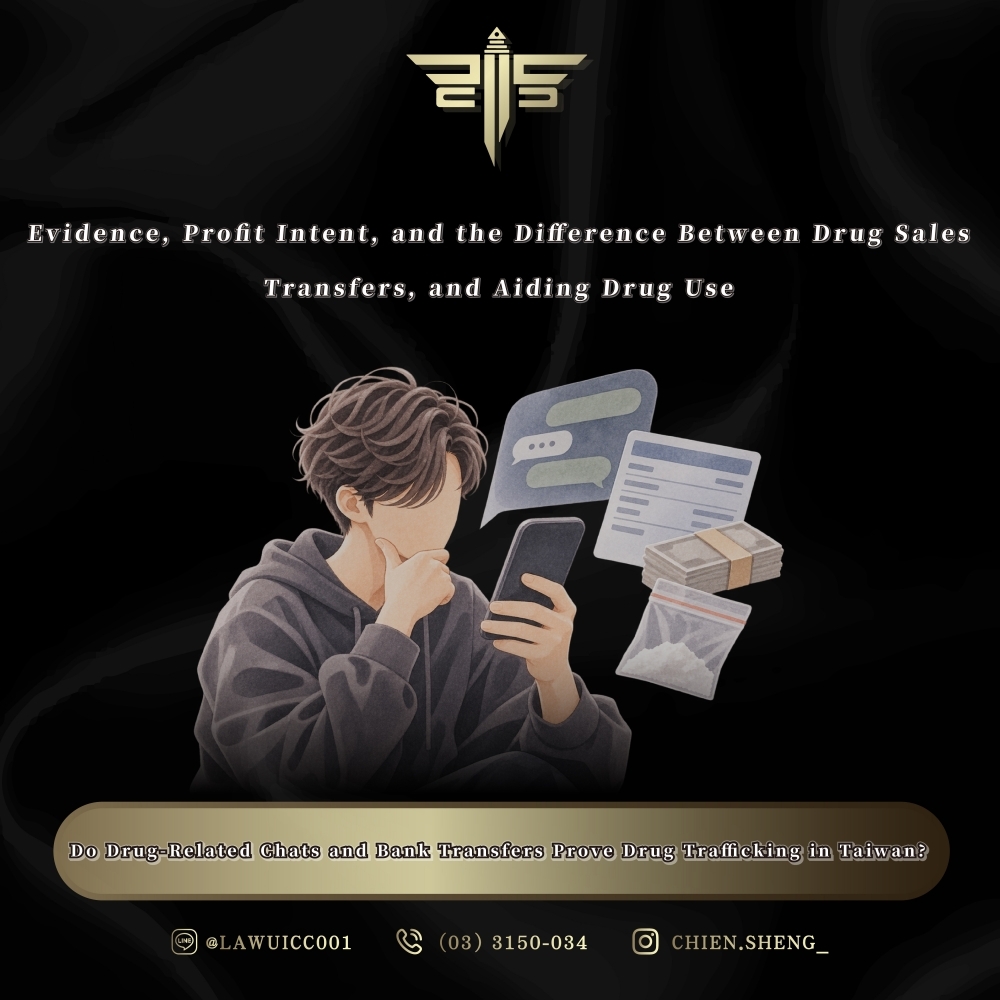
Do Drug-Related Chats and Bank Transfers Prove Drug Trafficking in Taiwan? Evidence, Profit Intent, and the Difference Between Drug Sales, Transfers, and Aiding Drug Use
Table of contents
- 1. Criminal Penalties for Drug Trafficking vs. Drug Transfers
- 2. Connecting Chat Records, Bank Transfers, and Drug Delivery
- 3. Does Receiving Money Prove Intent to Profit?
- 4. Joint Purchases, Drug Transfers, and Aiding Drug Use
- 5. How to Defend Against Drug Trafficking Allegations
- 6. Frequently Asked Questions About Drug Trafficking Evidence in Taiwan
- 7. Conclusion: Drug Trafficking Charges Require More Than Suspicious Messages and Payments
In Taiwan drug crime investigations, messages mentioning drug quantities, prices, or coded transaction terms, together with bank transfers involving similar amounts and dates, may become important evidence supporting suspicions of drug trafficking.
➡︎ However, the existence of these records does not automatically establish that a drug sale occurred.
The central legal question is whether the prosecution can establish a reliable connection between the conversations, the financial transactions, and the actual delivery of a specific controlled substance. It is also necessary to determine whether the defendant acted with the intent to profit.
These distinctions are particularly important because drug trafficking, unlawful drug transfers, and aiding drug use may involve substantially different criminal penalties under Taiwan's Narcotics Hazard Prevention Act.
1. Criminal Penalties for Drug Trafficking vs. Drug Transfers
1. Drug Trafficking Penalties Under Article 4
Article 4 of Taiwan's Narcotics Hazard Prevention Act establishes criminal penalties for manufacturing, transporting, and selling controlled drugs.
Selling Category 1 drugs may be punishable by death or life imprisonment, while selling Category 2 drugs may result in life imprisonment or imprisonment for at least ten years.
These severe penalties make the correct legal classification of the defendant's conduct particularly important.
2. Drug Transfer Penalties Under Article 8
Article 8 separately regulates the unlawful transfer of controlled drugs, with penalties depending on the drug category.Certain transfers involving quantities that meet statutory thresholds may also result in enhanced punishment.
Therefore, a case should not be classified solely according to the initial allegation recorded by investigators.
➡︎ The actual conduct, evidence, and applicable statutory elements must be examined to determine whether the case involves drug trafficking, drug transfer, or another offense.
2. Connecting Chat Records, Bank Transfers, and Drug Delivery
1. Chat Messages Must Be Examined in Context
Even if a conversation mentions quantities such as "several grams" or refers to a particular price, the complete context must be considered.
Investigators must determine whether the participants were actually discussing controlled substances, what the relevant words referred to, whether the quantities and prices were identifiable, and whether the conversation corresponded to an actual delivery.
Selected screenshots or isolated messages may omit important context.Suspicious language alone does not necessarily prove that a particular controlled substance was delivered.
2. A Bank Transfer Does Not Automatically Establish Drug Payment
Bank records can establish that money moved between accounts, but they do not independently establish why the transfer occurred.
➡︎ The prosecution must explain how the sender, recipient, transfer date, and amount correspond to the alleged conversation and drug delivery.
A transfer may have another explanation, such as repayment of a loan, reimbursement of expenses, or an unrelated financial arrangement.
Where alternative explanations are supported by evidence, they should be evaluated rather than assuming that similar amounts or closely related dates necessarily establish payment for drugs.
3. Drug Type, Classification, and Quantity Must Also Be Proven
Another important question is whether the evidence identifies the actual substance involved.Numbers or coded references in messages may not independently establish the type, classification, or quantity of a controlled drug.
➡︎ If investigators have seized substances, laboratory reports, delivery footage, witness testimony, or other objective evidence, the court may consider those materials together with the conversations and financial records.
Each category of evidence has a different evidentiary function.The prosecution must explain how the evidence supports and corroborates the alleged transaction as a whole.
3. Does Receiving Money Prove Intent to Profit?
1. Profit Intent Is an Important Legal Distinction
One important distinction between selling drugs and unlawfully transferring drugs concerns whether the person acted with the intent to profit.
Judicial interpretations summarized by Taiwan's Judicial Yuan indicate that delivering drugs in exchange for payment with an intent to profit may constitute drug trafficking.
➡︎ By contrast, transferring drugs at the original purchase price without an intent to profit may fall under the legal classification of drug transfer, depending on the circumstances.
Courts also distinguish situations involving joint purchases, purchasing drugs on another person's behalf, and sharing drugs among participants.
Depending on the actual conduct and subjective intent, certain circumstances may raise questions concerning aiding drug use rather than drug trafficking.
2. No Actual Profit Does Not Necessarily Mean No Profit Intent
A defendant cannot establish the absence of profit intent merely by showing that no money was ultimately earned.The relevant question concerns the defendant's intent at the time of the conduct.
Courts may examine the difference between purchase and resale prices, additional fees, how the drugs were obtained and distributed, repeated transaction arrangements, and the defendant's actual responsibilities.
➡︎ These circumstances may help determine whether the defendant intended to obtain a financial benefit.
3. Joint Purchases and Cost Sharing Require Separate Examination
If objective evidence indicates that several individuals jointly funded a purchase or shared the original cost without a profit motive, the conduct may require a different legal assessment.
➡︎ The existence of a financial transaction should not eliminate the need to examine whether the parties were sharing expenses, jointly purchasing drugs, or engaging in a commercial sale.
➡︎ The appropriate classification depends on the complete factual circumstances and the evidence supporting them.
4. Joint Purchases, Drug Transfers, and Aiding Drug Use
1. Different Conduct May Lead to Different Criminal Charges
Jointly purchasing drugs, purchasing drugs on another person's behalf, and distributing drugs among participants may differ from commercial drug trafficking.
➡︎ However, whether the conduct constitutes unlawful drug transfer, aiding drug use, or another offense depends on several factors.
These include how the substances were delivered, who obtained and controlled them, how the participants divided their responsibilities, and what each person intended.A claim that the defendant was merely helping with a purchase must also be supported by the actual evidence.
2. The Presumption of Innocence Still Applies
Under Taiwan's Code of Criminal Procedure, a defendant is presumed innocent until proven guilty through lawful criminal proceedings.Criminal facts must be established through evidence, and the prosecution bears the burden of proving the charged offense.
Chat records and bank transfers may be important evidence, but their existence alone does not necessarily establish drug trafficking.
➡︎ If material questions remain concerning the connection between the payment and the alleged drug transaction, the identity of the delivered substance, or the defendant's intent to profit, those questions must be addressed through the evidentiary process.
Several pieces of apparently similar evidence cannot simply be placed together and treated as conclusive proof without establishing how they relate to one another.
5. How to Defend Against Drug Trafficking Allegations
1. Preserve Complete Conversations and Financial Records
If a case involves drug-related messages, bank transfers, quantities, or alleged prices, the defendant should preserve complete and unaltered communications and financial records.
Relevant transaction dates, payment purposes, and the surrounding circumstances should be organized carefully.
➡︎ A single screenshot or bank transfer should not be used to reconstruct an entire alleged transaction without considering the remaining evidence.Defendants should not delete communications, records, fabricate explanations, or coordinate false statements.
2. Examine the Evidence Chain Before Determining the Appropriate Charge
 When handling drug-related criminal cases, Chien Sheng International Law Firm (謙聖國際法律事務所) examines the communications and financial transactions underlying the allegations.
Important questions include whether a payment can be connected to a specific drug delivery, whether the type and quantity of drugs are supported by reliable evidence, whether the defendant intended to profit, and whether the defendant's actual role supports a drug trafficking charge.
A careful review of the evidence chain may help distinguish drug trafficking from unlawful drug transfer, aiding drug use, or other legally relevant conduct.
➡︎ The appropriate defense strategy must be based on the complete case record and the applicable law.
6. Frequently Asked Questions About Drug Trafficking Evidence in Taiwan
Q1: Do chat messages mentioning drug quantities and prices prove drug trafficking in Taiwan?
Not automatically. The prosecution must establish the meaning of the messages and their connection to an actual drug transaction and the required elements of the charged offense.
Q2: Can a bank transfer be considered proof of payment for drugs?
A bank transfer may be relevant evidence, but it does not independently establish the reason for the payment. Its connection to the alleged transaction must be supported by the evidence.
Q3: What is the difference between drug trafficking and drug transfer in Taiwan?
An important distinction concerns the intent to profit. However, the actual conduct, payment arrangements, delivery circumstances, and applicable statutory requirements must be examined.
Q4: If the defendant made no profit, does that mean drug trafficking cannot be established?
No. The absence of actual profit does not necessarily establish the absence of an intent to profit when the conduct occurred.
Q5: Can purchasing drugs for another person constitute aiding drug use?
Depending on the circumstances, purchasing drugs on another person's behalf may raise questions involving drug transfer, aiding drug use, or other criminal liability. The legal classification depends on the actual conduct and intent.
Q6: What evidence should be examined in a drug trafficking case?
Relevant evidence may include complete chat histories, bank transactions, laboratory reports, seized substances, delivery records, surveillance footage, witness statements, and evidence concerning the defendant's role and intent.
7. Conclusion: Drug Trafficking Charges Require More Than Suspicious Messages and Payments
In Taiwan drug crime cases, conversations mentioning drug quantities or prices and bank transfers involving similar amounts may raise suspicion, but they do not automatically prove drug trafficking.
➡︎ The prosecution must establish how the conversations, financial transactions, and alleged delivery relate to the same transaction.
➡︎ The evidence must also support the relevant drug classification, quantity, and the defendant's intent and actual conduct.
Distinguishing drug trafficking from unlawful drug transfer, joint purchasing arrangements, or aiding drug use is particularly important because the legal consequences may differ substantially.
A criminal defense strategy should therefore begin with a careful examination of the evidence chain rather than relying solely on the initial charge or isolated pieces of evidence.
※ This article provides general legal information about Taiwan drug offenses and criminal evidence. It does not constitute individualized legal advice. The appropriate legal classification and outcome depend on the facts, evidence, and applicable law in each case.
This reduces both medical risks and potential legal exposure.
Chien Sheng International Law Firm
LINE Online Legal Consultation: @lawuicc001 (Click to consult)
Welcome to call to schedule a meeting: 03-3150-034
Multiple payment methods available: Cash, Credit Card, Bank Transfer
Facebook: Chien Sheng International Law Firm
Instagram: chien.sheng_
其它相關店家資訊


免責聲明本網站僅提供製造業公司資訊參考平台, 並不涉入其中任何諮詢、交易。本網站對各該製造業公司相關資訊亦不作任何實質或形式上之審查。就本網站中所載一切製造業公司的資訊、文字、照片、圖形 、產權、廣告內容、或其他資料(以下簡稱『內容』),無論其為公開張貼或私下傳送,若有不實或違法情事,均為『內容』提供者之責任,本站概不負責也不承擔任何法律責任