MIT PROCESSING , Made in Taiwan







謙聖國際法律事務所-專精詐欺、毒品刑事辯護及侵害配偶權律師

店家商品


商品名稱
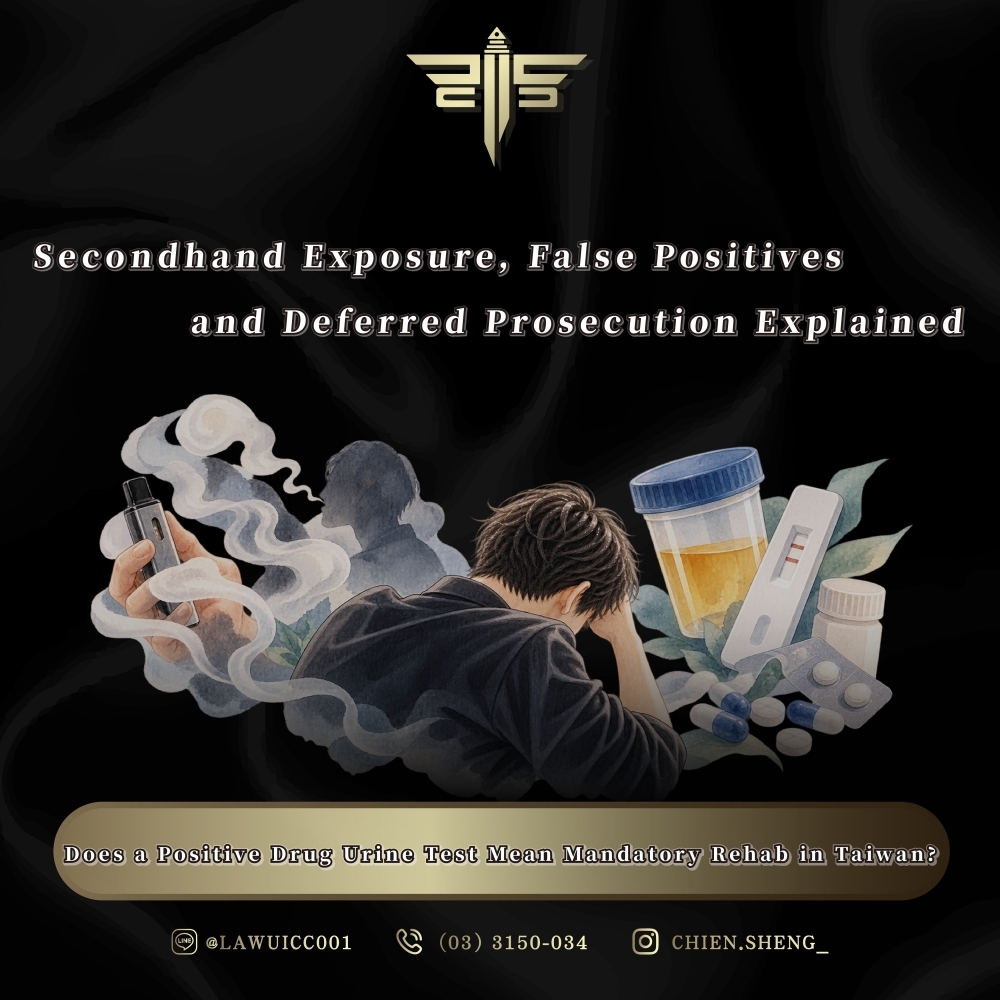
Does a Positive Drug Urine Test Mean Mandatory Rehab in Taiwan? Secondhand Exposure, False Positives, and Deferred Prosecution Explained
目錄
- 1. What Does a Positive Drug Urine Test Mean Under Taiwanese Law?
- 2. Can Secondhand Drug Smoke or Medication Cause a Positive Result?
- 3. Does a Confirmed Positive Urine Test Automatically Lead to Observation and Rehabilitation?
- 4. Can You Seek Deferred Prosecution with Addiction Treatment Instead?
- 5. What Are the Requirements and Risks of Addiction Treatment?
- 6. What Should a Lawyer Examine After a Positive Drug Test?
- 7. Frequently Asked Questions
Does a positive drug urine test automatically mean that you must enter a rehabilitation facility in Taiwan?
➡︎ Not necessarily.
A positive urine test can raise serious legal concerns, but its consequences depend on the testing method, the evidence of drug use, and the applicable criminal procedures.
An initial screening result is different from a laboratory-confirmed positive result. Even when confirmatory testing identifies a controlled substance or its metabolites, the authorities must still determine whether the evidence establishes an offense involving illegal drug use.
Furthermore, eligible defendants may seek deferred prosecution subject to addiction treatment under Article 24 of Taiwan's Narcotics Hazard Prevention Act rather than proceeding directly to observation and rehabilitation.
This article explains the differences between drug screening and confirmatory testing, the potential relevance of secondhand drug exposure and medication interference, and the legal options available after a positive urine test.
1. What Does a Positive Drug Urine Test Mean Under Taiwanese Law?
A positive drug test does not always carry the same evidentiary significance.
Taiwan's drug-testing regulations distinguish between preliminary screening and confirmatory laboratory analysis.
1. Preliminary Drug Screening
Initial urine screening commonly uses immunoassay-based methods to identify samples that may contain controlled substances.
These tests are relatively fast, but they may be affected by cross-reactivity or other analytical interference.
Consequently, a preliminary positive result does not necessarily establish that a person used an illegal drug.
Samples producing positive or questionable screening results generally require further confirmation under the applicable testing procedures.
2. Confirmatory Laboratory Testing
Confirmatory testing uses more specific analytical methods, such as gas chromatography–mass spectrometry (GC-MS) or liquid chromatography–mass spectrometry (LC-MS).
These methods help identify particular drugs or metabolites more reliably.
When reviewing a positive urine test, important information may include:
■ The preliminary and confirmatory test reports.
■ The specific drug or metabolite detected.
■ The analytical method and applicable cutoff concentration.
■ The actual measured concentration.
■ The date and time of sample collection and testing.
■ The sample identification and chain-of-custody records.
■ Whether a retained sample is available for legally permitted retesting.
Testing facilities must follow applicable requirements concerning sample handling, documentation, storage, and reporting.
A confirmed positive result is important evidence, but its legal significance must still be assessed alongside the collection procedure and other facts of the case.
2. Can Secondhand Drug Smoke or Medication Cause a Positive Result?
1. Secondhand Drug Smoke Exposure
Some individuals claim that they did not directly use drugs but were exposed to smoke from other people using methamphetamine, ketamine, or other substances.
Secondhand exposure may be relevant to an investigation, but it is not an automatic defense.
The assessment may involve:
■ Whether the location was enclosed or poorly ventilated.
■ The duration and intensity of exposure.
■ The substance allegedly used by another person.
■ The drug or metabolite detected in the urine.
■ The measured concentration and whether it is consistent with passive exposure.
■ Other evidence suggesting direct use, possession, or purchase.
A 2026 explanation published by the Taoyuan City Government's Department of Public Health indicated that passive exposure would generally not be expected to produce a positive urine result under ordinary circumstances. Any detectable concentration may depend on factors such as exposure duration, ventilation, and individual physiology.
Therefore, an argument based on secondhand smoke should be supported by scientific evidence and a credible explanation of the surrounding circumstances.
Simply stating that someone else was smoking drugs nearby is generally insufficient to disprove a confirmed positive result.
2. Cold Medicine, Prescription Drugs, and False Positives
Certain medications or substances may interfere with preliminary immunoassay screening and produce apparent positive results.
➡︎ If a person took prescription medication, over-the-counter cold medicine, supplements, or an unfamiliar product before testing, relevant records should be preserved.
These may include prescriptions, medication packaging, pharmacy receipts, and medical records.
However, it is essential to distinguish a preliminary screening reaction from a confirmed laboratory finding.
A medication that causes cross-reactivity during initial screening does not necessarily cause a positive result when a specific controlled substance is identified through confirmatory analysis.
Taiwan's Ministry of Health and Welfare has also clarified that legally manufactured traditional Chinese medicines do not inherently contain amphetamine or methamphetamine and should not be assumed to cause confirmed positive findings for those substances.
A medication-related defense must therefore identify the actual product, the substances involved, and the relevant testing mechanism.
3. Sample Collection and Chain-of-Custody Problems
Urine testing involves more than laboratory analysis.
The reliability of the evidence may also depend on lawful sample collection, proper labeling, sealing, transportation, storage, and documentation.
Potential issues include inconsistent sample numbers, incomplete chain-of-custody records, improper testing methods, or discrepancies between reported concentrations and applicable cutoff levels.
Constitutional Court Judgment No. 16 of 2022 addressed constitutional protections relating to compulsory urine collection, including bodily integrity, informational privacy, and procedural safeguards.
However, not every minor procedural irregularity makes a test result inadmissible or unreliable.The legal effect of any defect depends on its nature, seriousness, and relationship to the evidence.
3. Does a Confirmed Positive Urine Test Automatically Lead to Observation and Rehabilitation?
No. A confirmed positive test does not automatically result in compulsory observation and rehabilitation.
Article 10 of Taiwan's Narcotics Hazard Prevention Act criminalizes the use of Category 1 and Category 2 narcotics.
For qualifying drug-use cases, Article 20 establishes a procedure under which prosecutors generally apply to the court for an observation and rehabilitation order.
The court must issue the relevant order before the person is placed in an observation and rehabilitation facility.
1. Observation and Rehabilitation
The observation and rehabilitation period must not exceed two months.
During this period, the facility assesses whether the individual has a continuing tendency to use drugs.
➡︎ If the assessment finds no continuing tendency, the person should be released and the prosecutor should issue a non-prosecution disposition in accordance with the applicable law.
2. Compulsory Addiction Treatment
If the assessment identifies a continuing tendency to use drugs, the case may proceed to compulsory addiction treatment following the required legal procedures.
Compulsory treatment generally lasts between six months and one year, subject to the applicable statutory rules.
It is a separate stage from the initial observation and rehabilitation process.
A positive urine test alone does not automatically establish the need for compulsory treatment.
3. What Happens If the Person Has a Previous Drug-Use Case?
Previous treatment history can affect the procedure.
Under the relevant provisions, the legal consequences differ depending on whether the new offense occurred within three years after release from completed observation and rehabilitation or compulsory treatment.
The precise nature and timing of the previous proceedings must be examined.
A prior conviction, a previous rehabilitation order, and deferred prosecution with addiction treatment do not necessarily have identical legal effects.
4. Can You Seek Deferred Prosecution with Addiction Treatment Instead?
Yes. Under Article 24 of the Narcotics Hazard Prevention Act, prosecutors may consider deferred prosecution with conditions requiring addiction treatment in qualifying drug-use cases.
This alternative may allow an eligible person to receive treatment under prosecutorial supervision instead of immediately entering the observation and rehabilitation process.
However, deferred prosecution is discretionary and is not automatically granted upon request.
Before making the relevant disposition, the prosecutor must consult a medical institution as required by law.
Factors that may support consideration of treatment include:
■ A genuine willingness to receive addiction treatment.
■ A medical assessment indicating that treatment is appropriate.
■ Stable employment or family support.
■ The ability to attend regular outpatient appointments.
■ Willingness to comply with urine testing and supervision requirements.
■ A realistic plan to reduce the risk of further drug use.
These factors do not guarantee approval, but they may help demonstrate that a treatment-based approach is suitable.
Why Is Early Preparation Important?
➡︎ If a case remains under investigation, defense counsel may assist the defendant in obtaining medical assessments, documenting treatment willingness, and presenting relevant circumstances to the prosecutor.
The objective is not to disregard evidence of drug use.
Instead, the defense may argue that medically supervised treatment offers an appropriate legal response for the individual case.
5. What Are the Requirements and Risks of Addiction Treatment?
1. Who May Qualify?
The relevant addiction treatment framework primarily concerns individuals accused of using Category 1 or Category 2 narcotics.
Medical professionals assess factors such as substance-use severity, mental health conditions, and treatment suitability.
Other pending criminal cases, detention, or imprisonment may affect whether a defendant can realistically complete treatment.
Eligibility must be determined individually.
2. What Does Treatment Involve?
Addiction treatment may include medication, psychological counseling, rehabilitation services, drug testing, and relapse-prevention measures.
Treatment is generally provided through outpatient or other noncustodial arrangements where appropriate.
More intensive treatment may be considered when medically necessary and legally permitted.
Under the relevant treatment regulations, a single treatment course may last up to one continuous year.
Deferred prosecution with addiction treatment is therefore not an unconditional release from legal responsibility.
The defendant must comply with the treatment plan and other conditions imposed by the prosecutor.
3. What If Another Drug Test Is Positive During Treatment?
■ A positive drug test during the deferred prosecution period may indicate noncompliance or failure to complete treatment under the applicable rules.
■ A positive result within the specified period before treatment completion may also affect the treatment assessment.
Where statutory grounds exist, the prosecutor may revoke deferred prosecution.
➡︎ If deferred prosecution is revoked, the case may return to investigation or prosecution under Article 24.
Accordingly, the purpose of treatment-based deferred prosecution is to support rehabilitation and prevent further drug use, not merely to delay criminal proceedings.
6. What Should a Lawyer Examine After a Positive Drug Test?
A criminal defense lawyer should evaluate both the scientific evidence and the available legal procedures.
1. Confirm the Type of Test
The first step is to determine whether the result came from preliminary screening or confirmatory laboratory analysis.
These results should not be treated as interchangeable.
2. Review Drug Types, Metabolites, and Concentrations
Different substances have different detection characteristics.
Urine concentrations may be affected by dosage, frequency of use, metabolism, hydration, and testing methods.
The lawyer should compare the laboratory findings with the alleged offense date and the other evidence.
A positive result does not necessarily establish the exact time, amount, or circumstances of drug use.
3. Examine Medication and Unintentional Exposure
Where medication interference or unknowing exposure is alleged, the defense should obtain objective supporting evidence.
This may include prescriptions, product packaging, medical records, purchase records, and relevant communications.
The explanation must be consistent with the actual laboratory findings.
4. Investigate Possible Secondhand Exposure
➡︎ If passive exposure is raised as a defense, relevant details include the location, ventilation, exposure duration, substance involved, and urine concentration.
Expert analysis may be necessary in cases where the scientific interpretation is disputed.
5. Evaluate Treatment-Based Deferred Prosecution
Even when the evidence strongly supports actual drug use, the defense should consider whether Article 24 provides a viable alternative.
Medical suitability, treatment willingness, employment, family support, and the defendant's previous drug-related history may all be relevant.
The appropriate strategy depends on the facts and procedural stage.
7. Frequently Asked Questions
Q1: Does a positive police drug screening mean I must enter rehabilitation?
No. Preliminary screening generally requires confirmation, and any subsequent observation and rehabilitation order must follow the applicable legal procedures.
Q2: Does a confirmed positive urine test automatically require observation and rehabilitation?
No. A confirmed result is important evidence, but the authorities must still assess the alleged offense and follow the required procedures. Deferred prosecution with addiction treatment may also be available in qualifying cases.
Q3: Can secondhand drug smoke explain a positive urine test?
It may be relevant in some circumstances, but passive exposure is not an automatic defense. The explanation must be supported by the exposure conditions, laboratory findings, and other evidence.
Q4: Can cold medicine or traditional Chinese medicine cause a positive drug test?
Some medications may interfere with preliminary screening. However, this does not mean that ordinary medications will produce a confirmed positive result for a specific controlled substance.
Q5: Can I request addiction treatment if I actually used drugs?
Potentially. Article 24 allows prosecutors to consider deferred prosecution with addiction treatment for eligible cases, subject to medical assessment and statutory requirements.
Q6: What happens if I test positive again during deferred prosecution?
A further positive result may affect treatment completion and may provide grounds for revoking deferred prosecution. The legal consequences depend on the applicable rules and case circumstances.
Q7: What if I have already received a court order for observation and rehabilitation?
The available options depend on the order, service date, procedural status, and execution schedule. A lawyer should review the court order, laboratory reports, and previous case records promptly to determine whether a lawful challenge or other procedural remedy is available.
Conclusion: A Positive Drug Test Is Not the End of the Legal Analysis
A positive drug urine test can have serious consequences in Taiwan, but it does not automatically establish every element of a criminal offense or require immediate placement in an observation and rehabilitation facility.
Where only preliminary screening has been completed, confirmatory testing is essential.
Where confirmatory testing is positive, the evidence should still be reviewed for analytical reliability, medication interference, sample handling, and the circumstances of the alleged drug use.
Even where actual drug use is established, eligible defendants may seek deferred prosecution with addiction treatment rather than proceeding directly through the observation and rehabilitation system.
The most important step is to examine the scientific evidence, the applicable criminal procedure, and the available treatment options together.
 Chien Sheng International Law Firm provides assistance in drug-use cases involving positive urine tests, observation and rehabilitation proceedings, challenges to testing evidence, and applications for treatment-based deferred prosecution.
Individuals who receive police notices, prosecutorial summonses, or court orders should seek qualified legal advice promptly to protect their procedural rights and evaluate the available options.
※ This article is provided for general legal information and educational purposes. The interpretation of drug test results requires consideration of laboratory methods, scientific evidence, and the circumstances of each case. Observation and rehabilitation, compulsory treatment, and deferred prosecution are governed by specific statutory requirements and prosecutorial or judicial decisions. No particular defense, treatment arrangement, or case outcome is guaranteed. This article does not replace individualized advice from a qualified Taiwan criminal defense attorney.
This reduces both medical risks and potential legal exposure.
Chien Sheng International Law Firm
LINE Online Legal Consultation: @lawuicc001 (Click to consult)
Welcome to call to schedule a meeting: 03-3150-034
Multiple payment methods available: Cash, Credit Card, Bank Transfer
Facebook: Chien Sheng International Law Firm
Instagram: chien.sheng_
其它相關店家資訊


免責聲明本網站僅提供製造業公司資訊參考平台, 並不涉入其中任何諮詢、交易。本網站對各該製造業公司相關資訊亦不作任何實質或形式上之審查。就本網站中所載一切製造業公司的資訊、文字、照片、圖形 、產權、廣告內容、或其他資料(以下簡稱『內容』),無論其為公開張貼或私下傳送,若有不實或違法情事,均為『內容』提供者之責任,本站概不負責也不承擔任何法律責任